
The hydraulic bulging process for stainless steel tees is as follows:
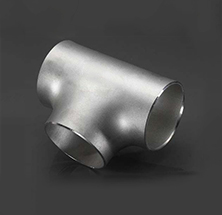
The receiving ends of equal diameter tees are of the same size; The main pipe of the reducing tee has the same receiving size, while the receiving size of the branch pipe is smaller than that of the main pipe. Hydraulic bulging of the tee is a forming process that expands the branch pipe through axial compensation of metal materials. The process involves using a specialized hydraulic press to inject liquid into a billet with a diameter equal to that of a tee.
Through the synchronous centering motion of the two degree side cylinders of the hydraulic press, the tube blank is squeezed and its volume decreases. The liquid inside the tube blank increases in pressure as the volume of the tube blank decreases. When the required pressure for the expansion of the three-way branch pipe is reached, the metal material moves along the mold cavity and expands out of the branch pipe under the dual action of the side cylinder and the liquid pressure inside the tube blank.
The hydraulic bulging process of three-way can be formed in one go, with high consumption efficiency; The thickness of the main pipe and shoulder wall of the tee has increased. Due to the large equipment tonnage required for the hydraulic bulging process of seamless tees, it is currently mainly used in the manufacturing of standard wall thickness tees smaller than DN400 in China. Its applicable forming materials are low carbon steel, low alloy steel, stainless steel with relatively low cold work hardening tendency, including some non-ferrous metal materials such as copper, aluminum, titanium, etc.
Triple hot pressing is the process of flattening a billet larger than the diameter of a tee to a size approximately equal to the diameter of the tee, and creating a hole at the location where the branch pipe is stretched; The pipe blank is heated and placed into the forming mold, and a die for stretching the branch pipe is inserted into the pipe blank; Under the action of pressure, the pipe blank is radially compressed, and during the radial compression process, the metal moves towards the branch pipe direction and forms the branch pipe under the stretching of the die.
 CHINESE

